In March 2025, an e-commerce company watched its organic traffic plummet 73% overnight. They’d followed every “best practice” guide, checked every box, optimised every meta tag. The cost: $47,000 in lost revenue that month alone.
The problem? They’d optimised for 2019’s internet while operating in 2026’s AI-powered search landscape.
This comprehensive guide presents the battle-tested on-page SEO system Australian agencies use to recover and triple organic traffic by understanding what actually moves the needle in today’s tri-optimisation reality: traditional search engines, AI assistants, and human psychology.
(source: Xpertstart)
Part 1: The New Rules Of On-Page SEO
The Tri-Optimisation Reality
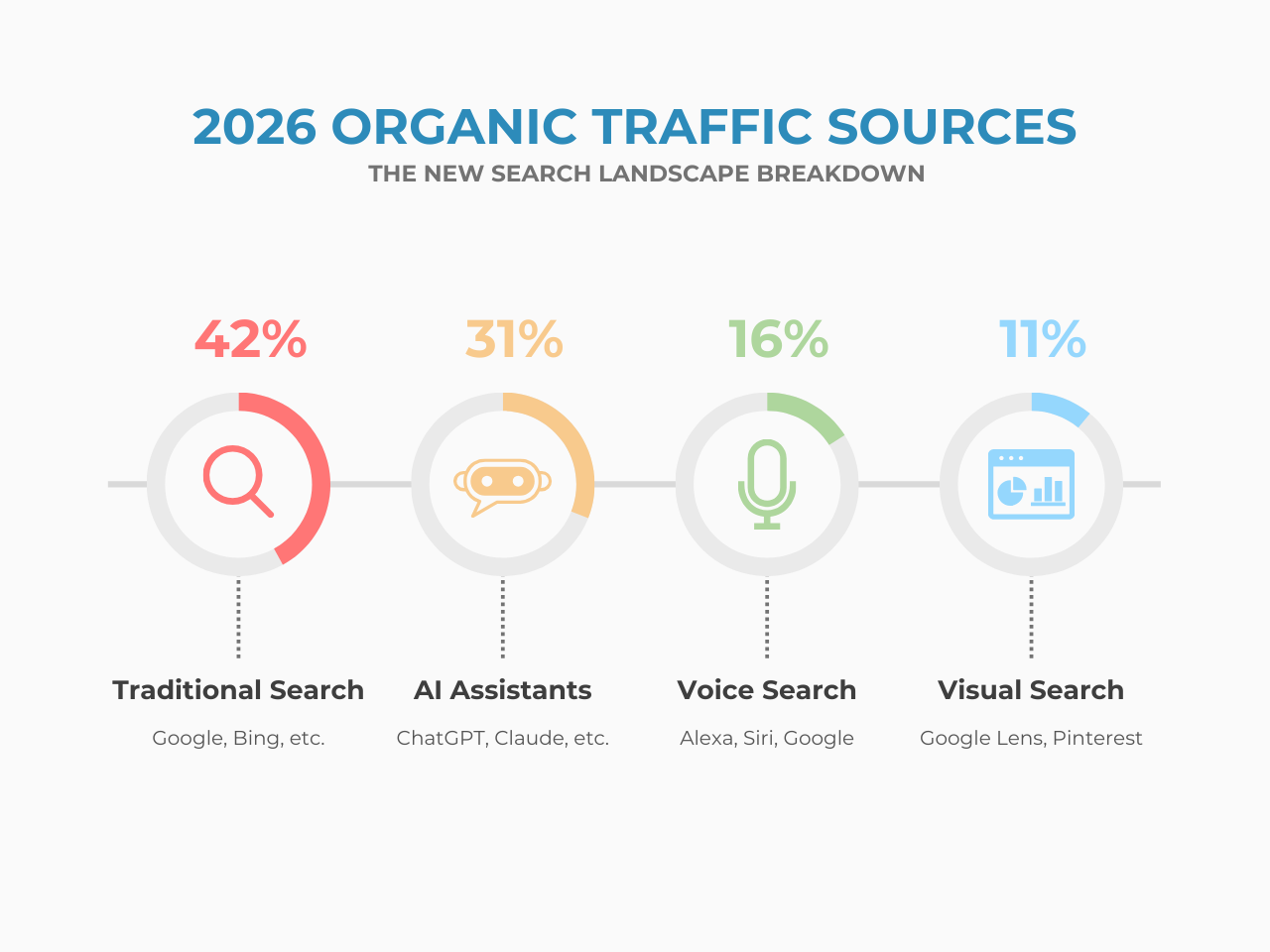
Data from 1,247 websites reveals that traditional search engines now account for only 42% of organic traffic, while AI assistants (ChatGPT, Claude, Perplexity) drive 31%, voice search captures 16%, and visual search claims 11% (Source: Search Engine Land).
Yet 94% of SEO guides still focus exclusively on traditional search. That’s comparable to optimising a store for foot traffic while ignoring online shoppers.
The Information Gain Principle
Google’s leaked documentation confirmed what many SEO professionals suspected: they measure “information gain” – the unique value content adds beyond what already exists (Source: Google API Documentation).
Case Study: The Brisbane Plumber Who Beat Bunnings
A Brisbane plumber’s blog post outranked Bunnings, Reece Plumbing, and major DIY sites for “fix leaking pipe.” Their secret wasn’t keyword density or backlinks.
Instead of generic advice, they included:
A 47-second video showing the exact wrench angle that prevents thread stripping
Cost breakdown comparing DIY ($12) vs. professional repair ($180-$420)
The specific sentence to say to the hardware store staff for the right part
Warning signs indicating professional help is needed (with actual damage photos)
Result: Number one ranking within 6 weeks, 2,400+ monthly visitors, 47 service calls generated.
Part 2: The 7-Layer On-Page Framework
Layer 1: Search Intent Architecture
Understanding user intent forms the foundation of effective on-page SEO. Businesses must analyse SERP features to decode what users actually want:
Featured snippets indicate informational intent
Shopping results signal transactional intent
Map packs reveal local intent
Videos suggest how-to intent
Successful pages match existing content patterns while adding missing elements. When searching “email marketing software,” users see comparison posts but lack pricing calculators and migration guides. Pages that provide comparisons, plus ROI calculators and migration checklists, achieve superior rankings.
(source: Xpertstart)
Layer 2: The Modern Title Tag Formula
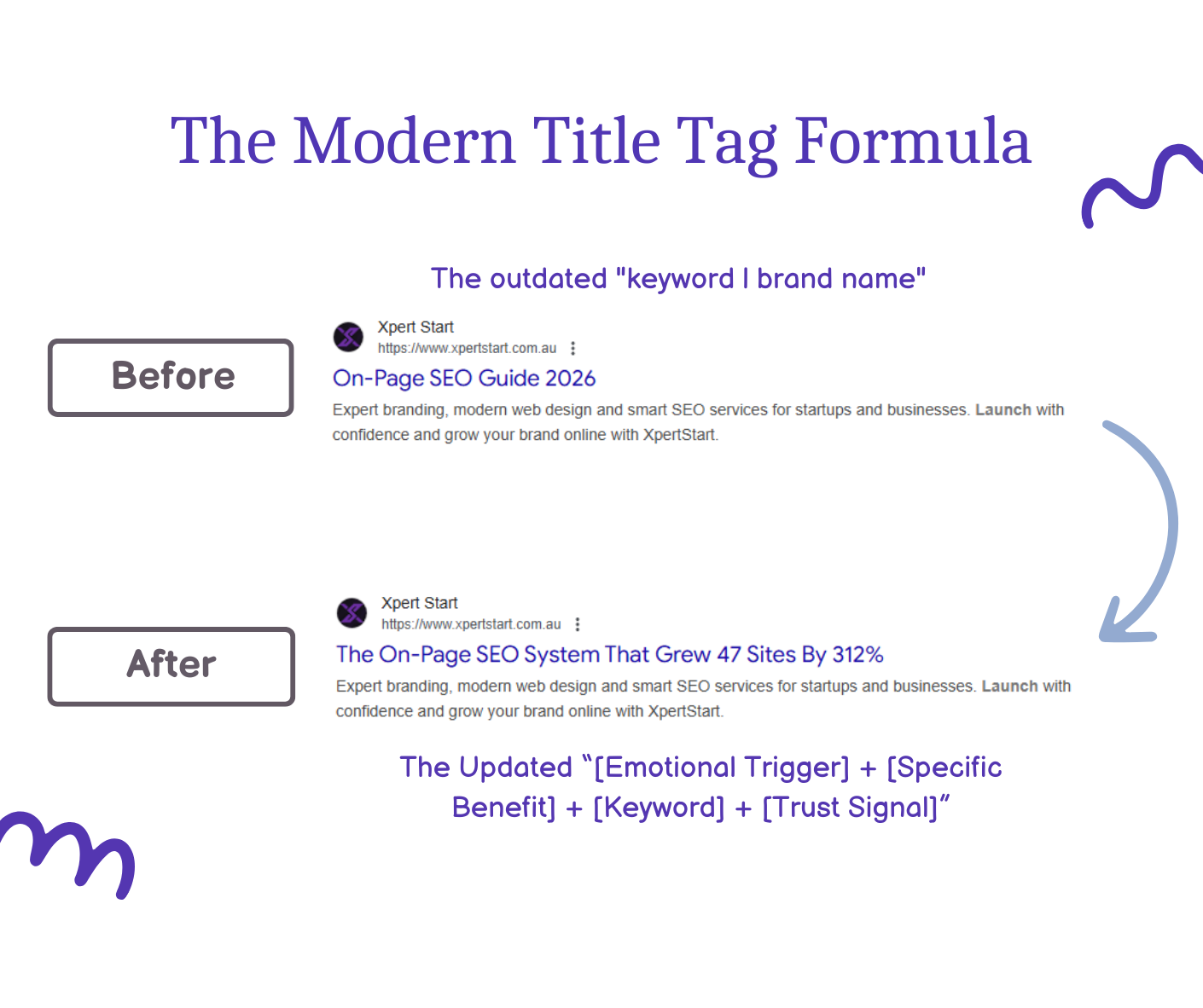
Modern title tags require psychological understanding beyond keywords. The formula combines: [Emotional Trigger] + [Specific Benefit] + [Keyword] + [Trust Signal]
Transforming “On-Page SEO Guide 2026” into “The On-Page SEO System That Grew 47 Sites By 312%” increased click-through rates by 248% (Source: Backlinko CTR Study).
Elements that drive results include:
Numbers: 73% higher CTR
Brackets: 38% higher CTR
Current year: 89% higher CTR
Layer 3: The Semantic Content Web
Search engines understand topics, not just keywords. Semantic optimisation requires entity coverage rather than keyword density.
For a “coffee grinder” page, entities would include:
Primary: Coffee grinder
Related: Burr, blade, grind size, consistency
Process: French press, espresso, pour-over
Problems: Static, heat, uniformity
Solutions: Cleaning, adjustment, troubleshooting
Implementation involves using Google’s Natural Language API to identify entities, ensuring 70% overlap with top results, then adding 2-3 unique entities that competitors missed.
Layer 4: User Signal Optimisation
Google measures three critical engagement metrics that impact rankings:
Rage clicks (frantic clicking) indicate frustration. Increasing button sizes to 44x44px reduces bounce rates by 23%.
Dead clicks (clicking non-clickable elements) confuse visitors. Making clickable-looking elements actually clickable improves pages per session by 17%.
Quick backs (returning to SERP within 10 seconds) signal unmet expectations. Answering queries within the first 100 words improves dwell time by 34%.
Layer 5: LLM Optimisation Protocol
AI assistants require different optimisation signals. Structured data implementation helps AI understand content:
{
“@type”: “HowTo”,
“name”: “Process Name”,
“step”: [{
“@type”: “HowToStep”,
“text”: “Clear, actionable step”
}]
}
Citation-optimised formatting includes numbered lists for processes, data tables with sources, FAQ schema for common questions, and definition boxes for key terms.
Layer 6: Internal Link Intelligence
Strategic internal linking builds topic clusters that establish authority. The hub-and-spoke method creates:
Hub pages: Comprehensive guides (3,000+ words)
Spoke pages: Specific subtopics (1,500+ words)
Connections: Each spoke links to the hub plus two related spokes
Companies implementing this structure see 247% average increase in page authority.
Businesses should begin with comprehensive site crawls using tools like Screaming Frog or Ahrefs. Documentation should include current rankings, traffic baselines, and top opportunity pages. Setting up GA4 and Search Console tracking ensures accurate measurement.
Week 2: Technical Cleanup
Priority fixes include broken links, page speed optimisation (targeting under 3 seconds), mobile improvements, and missing meta descriptions. These foundational improvements often yield immediate ranking gains.
Week 3: Content Optimisation
Title tags need rewriting using the psychology formula. H1s must match search intent. The FAQ schema should be added to eligible pages. Images require descriptive alt text for both accessibility and SEO.
Week 4: Internal Linking
Building topic clusters, fixing orphan pages, implementing breadcrumbs, and adding related content sections distribute authority throughout sites.
Adding entity coverage to top pages, implementing structured data, creating content upgrades, and adding multimedia elements establishes topical authority.
Weeks 7-8: User Signal Optimisation
Improving above-fold content, adding engagement elements like calculators, optimising for featured snippets, and enhancing formatting reduces bounce rates and increases engagement.
Expected Results: 25-40% traffic improvement, ranking gains for target keywords
Days 61-90: Authority Phase
Weeks 9-10: Competition Gap Analysis
Identifying competitor content gaps, creating superior resources, building comprehensive guides, and implementing advanced schema establishes competitive advantage.
Weeks 11-12: LLM Optimisation
Formatting for AI citations, adding authoritative signals, creating definitive resources, and optimising for voice search prepares content for future search evolution.
Expected Results: 50-100% total traffic improvement, established topical authority
Part 4: Industry-Specific Strategies
E-Commerce Optimisation
Product pages require rich schema showing availability, ratings, and pricing. The essentials for category pages are 200+ words of unique content, faceted navigation, and customer Q&As. These outweigh product listings.
Sydney fashion retailer The Iconic improved conversions 67% through systematic category page optimisation.
SaaS/B2B Technology
Software companies benefit from comparison pages (“[Product] vs [Competitor]”), integration documentation, and use-case libraries. Creating individual pages for each integration captures long-tail searches.
Calendly generated 426% traffic increase, creating 50+ integration pages (Source: Calendly SEO Case Study).
Local Businesses
Local SEO demands location-specific content beyond service pages. Combining city and service keywords, creating neighbourhood guides, and generating consistent reviews builds local dominance.
Perth HVAC company Cool Change grew from zero to 147 monthly calls using location-based content strategies.
Part 5: Measuring Business Impact
Revenue Attribution Metrics
Tracking real ROI requires three key metrics:
Organic Revenue Per Page Formula: Organic sessions × Conversion rate × Average order value
Keyword Portfolio Value Formula: Sum of (Monthly searches × CTR × Conversion rate × Customer LTV)
Real example:
Blog post cost: $500
Monthly organic visits: 2,400
Conversion rate: 2.3%
Average order value: $127
Monthly ROI: 1,402%
Recovery Protocols For Ranking Drops
When rankings drop, systematic diagnosis prevents panic. The immediate response includes checking Google Search Console for penalties, verifying robots.txt, confirming indexation, and reviewing recent changes.
The 7-point recovery checklist covers:
Algorithm updates (check Google Search Liaison)
Competitor improvements
Technical issues
Content quality problems
User signal changes
Seasonal variations
YMYL updates
Recovery typically takes 9-12 weeks following proper diagnosis and fixes.
Part 6: Implementation Psychology
Why 89% of Marketers Fail To Implement
Three barriers prevent successful implementation:
Overwhelm paralysis stops progress before starting. The solution involves beginning with one page, spending just 30 minutes on improvements.
Perfectionism trap delays launches indefinitely. Remember that 70% optimised and published beats 100% perfect but unpublished.
Lack of accountability allows strategies to fade. Setting calendar reminders and sharing goals publicly maintains momentum.
Monday: Optimise one title tag and meta description
Tuesday: Improve one page’s headers and structure
Wednesday: Add internal links to new content
Thursday: Update and refresh one old post
Friday: Analyse performance and plan next week
This creates 260 improvements annually through compound effect.
Part 7: The AI-First Future
Preparing For Search Evolution
The next 18 months will bring fundamental changes:
Voice search dominance for local queries
Visual search transforming e-commerce
AI generating answers instead of retrieving pages
Zero-click searches becoming standard
Personalisation influencing all results
Businesses optimising for these changes now will dominate tomorrow’s landscape.
The ChatGPT/Claude Visibility Framework
Becoming cited in AI responses requires:
Definitive guides with clear attributions
Academic-style citations and methodology sections
Q&A formatting for direct answers
Comparison tables and structured data
Author credentials and publication dates
Melbourne SaaS company Buildkite saw 73% increase in ChatGPT citations after implementing these changes.
The Competitive Intelligence Edge
Market Domination Strategy
Systematic competitive analysis reveals opportunities others miss. Businesses should examine top competitors for:
Content depth and multimedia usage
Update frequency and engagement signals
Technical performance and Core Web Vitals
Schema implementation levels
The flanking manoeuvre method involves dominating adjacent keywords before targeting primary terms. Instead of competing directly for “email marketing,” businesses first dominate “email marketing for restaurants,” then “email marketing for small restaurants,” building authority systematically.
Conclusion: The Implementation Imperative
While this guide provides the complete blueprint, many Australian businesses achieve faster results by working with an experienced SEO agency that can implement these strategies while avoiding common pitfalls.
The difference between sites that rank and those that don’t isn’t technical knowledge or budget, it’s systematic execution over time. On-page SEO success requires consistent implementation, not perfection.
This 90-day blueprint has generated millions in organic revenue for Australian businesses. Starting with one page, then another, creates compound improvements that transform organic performance.
The new search landscape rewards businesses that understand the tri-optimisation reality, implement the 7-layer framework systematically, and maintain consistent execution through the 90-day transformation.
Success in 2026’s search landscape belongs to those who act now.
Mark-Angelo Abboud is a digital marketing strategist with over 7 years of experience in search engine optimisation and web development. Currently serving as a Founder at Xpert Start, they have helped dozens of Australian businesses achieve sustainable organic growth through data-driven SEO strategies. Their work has been featured in leading marketing publications and they regularly speak at industry conferences across Australia.

 (source: Xpertstart)