



Building an SEO strategy in 2025 doesn’t need to be complicated.
In fact, by focusing on the fundamentals like keyword research, competitor analysis, content creation, and link building, businesses can still achieve fast, measurable results.
This system can be implemented as follows.
Step 1: Keyword Research
Every successful SEO strategy starts with keyword research.
Keyword research is the process of identifying the exact phrases a target audience is typing into Google.
Once these keywords are known, businesses can create content that addresses those search intents directly, attracting the right people into their sales funnel.
Today, AI makes keyword research easier than ever. Tools such as ChatGPT can generate seed keywords and long-tail keyword variations in seconds.
For instance, a prompt like (using the deep research function):
“I have a business in [industry]. Find some seed keywords and long-tail keywords I can target.”
…will quickly return a list of relevant phrases.
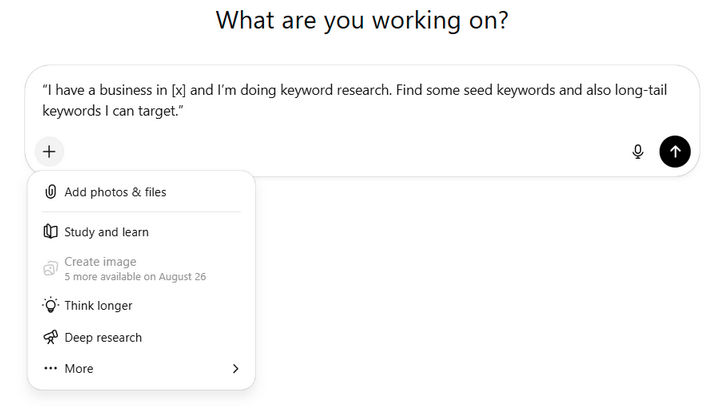

Once the keywords are gathered, ChatGPT can generate relevant keyword variations for businesses to target.
Here’s an example of how ChatGPT helped find keywords for an SEO Agency in New Zealand:
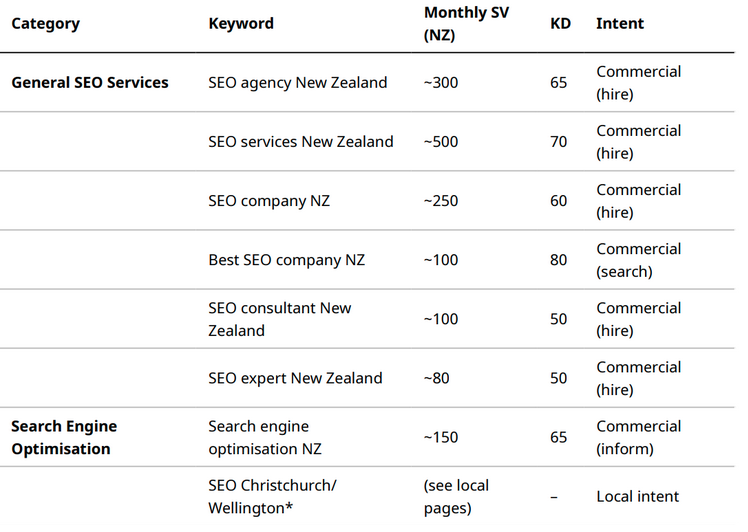

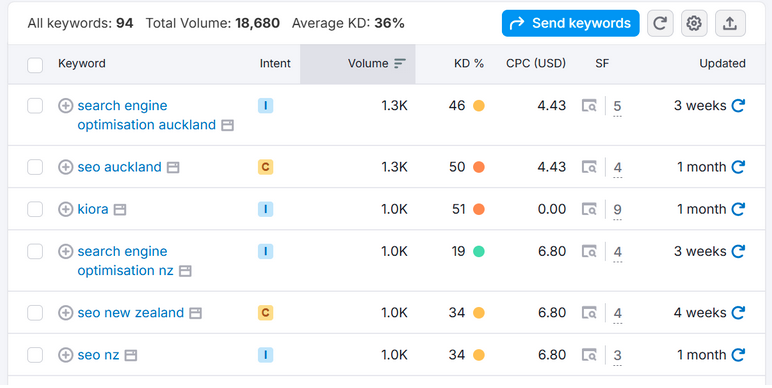
It’s important to note that AI keyword metrics aren’t always 100% accurate.
To validate results, marketers can use paid tools such as Semrush:

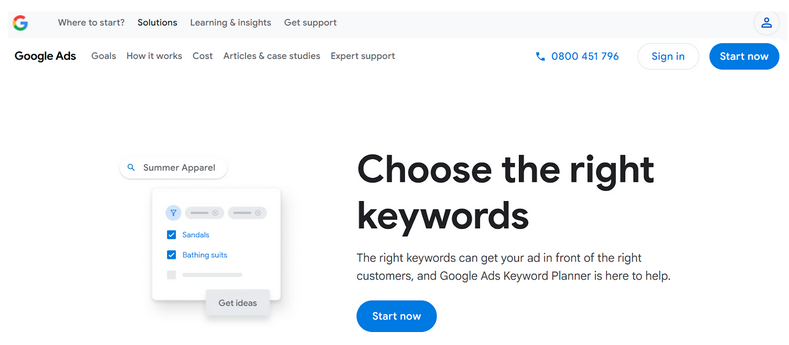
Or free tools like Google Keyword Planner (Source: Google Keyword Planner).

At the end of this process, there should be a list of keywords with an estimated monthly search volume relevant to the business.
These can then be added to a Google Sheet for organisation, making it easier to manage and refer back to when planning and creating content.
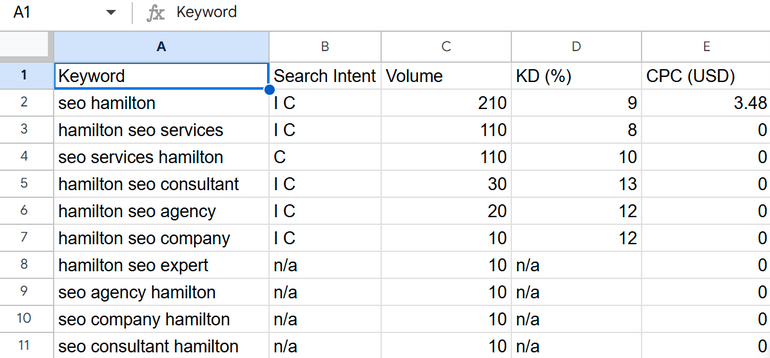

The next step is to take each discovered keyword and search for it on Google to conduct competitor analysis.
Step 2: Competitor Analysis
Competitor analysis involves assessing SEO rivals and their content to identify potential advantages.
Key areas to evaluate include:
- Content quality
- Page load speed
- Use of image alt text
- Effectiveness of meta titles and descriptions
…and other factors that may impact search performance.
These gaps represent clear opportunities.
By including the elements missing on the competitor’s homepage, a website can gain a significant advantage.
For instance, examining the first website may reveal its strengths and weaknesses, providing insights into opportunities for improvement.
These gaps represent clear opportunities. By including the elements missing on the competitor’s homepage, a website can gain a significant advantage.
An evaluation using Ahrefs’ Website Authority Checker assigned the competitor’s domain a score.
This tool provides a benchmark score indicating a website’s authority based on Ahrefs’ standards.
This same process should be applied to at least the top three search results, providing a clear understanding of the competition and highlighting opportunities to outperform them.
The collected information can be organised in a Google Sheet with columns for:
- Target keyword
- Competitor URL
- Gaps in their content that can be improved upon
- Domain rating
At this stage, all the necessary preparation has been completed, and it is now time to begin creating content.
Step 3: Content Creation
Before creating content, it is important to consider several key questions:
- Who is the content intended for?
- What outcomes or solutions is the reader seeking?
- How can trust be established with the audience?
- How can the business demonstrate its ability to help effectively?
This approach can be applied to any target keyword. However, effective content goes beyond this basic intent by addressing deeper questions:
- What does the reader need to see first to build trust?
- What specific benefits or results are they hoping to achieve?
- What information or presentation will make them feel confident engaging with the agency?
- Why should this agency be chosen over competitors?
By reverse-engineering content from the audience’s perspective, the creation process becomes more strategic and effective.
This process should be repeated for every keyword on the list to ensure comprehensive coverage and maximise SEO opportunities.
Step 4: Link Building
Once content is in place, the next step is building links.
A backlink occurs when another website links to your site, typically because the linking site considers the content relevant and valuable to its audience.
Backlinks not only improve the ranking of the specific page but also increase the overall authority of the website in Google’s eyes.
This, in turn, makes it easier to rank for targeted keywords when publishing new content.
One of the simplest and most effective methods for acquiring backlinks is through guest posting.
Guest posting involves publishing a high-quality article on another website that includes a link back to the contributor’s own site.
This approach benefits both parties: the host site receives valuable content, while the contributor gains a relevant backlink.
Tools such as ChatGPT can assist in identifying suitable guest posting opportunities in the relevant industry.
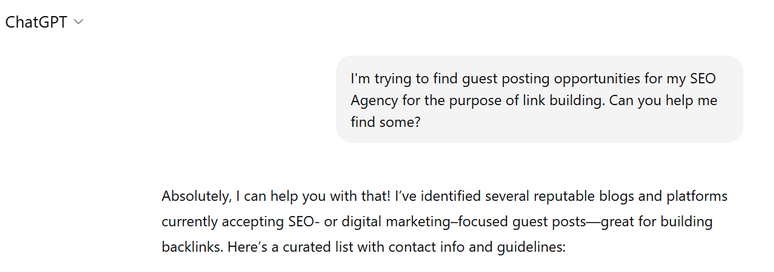

Once relevant guest posting opportunities are identified, they can be organised in a spreadsheet for outreach.
Wrapping it all up
This is how an effective SEO strategy can be built in 2025.
The process is straightforward and relies on the core elements of SEO:
- Keyword research
- Competitor analysis
- Content creation
- Link building
By consistently applying this process to every target keyword, businesses can steadily improve their search engine rankings and achieve long-term SEO success.
Enjoyed this technology and digital marketing article? Here are some more articles: